

AI is doing all the work, so why am I still paying you?
AI makes the hours cheaper, not the accountability. Why services firms should price the outcome, not the time, and how to set the number.

If AI does 90% of the work, should the price drop 90%?
Every services leader has heard it. The final presentation is going well, and then the client’s CFO leans forward: “We read that AI now writes three-quarters of Google’s code. If AI is doing the work, why aren’t we paying less?”
It’s a fair question. It’s also the wrong one, and how you answer it decides whether AI grows your margin or hands it straight back to your clients.
It’s even more challenging if you build AI solutions. Your pitch is that AI replaces manual work and makes it faster, better and cheaper. The client’s next thought is obvious: then your AI should make you cheaper too.
The headlines say AI does most of the work. The data says something different. Bain & Company finds that teams using AI coding assistants gain 10% to 15% in productivity. Meanwhile, clients of India’s IT services firms are asking for the same work for 25% to 30% less, and Infosys has walked away from contracts that no longer add up.
The problem isn’t AI. It’s that we taught clients to buy hours. The way out is to stop selling hours AI has made cheap and start selling what it can’t: certainty, accountability and the result itself. Let’s break it down.
Why 75% of the code isn’t 75% of the cost
Computer scientists have understood this gap for almost 60 years. In 1967, Gene Amdahl showed that speeding up part of a job only speeds up the whole as far as the rest of the job allows. The rule is usually written as (Hill and Marty, 2008):
Overall speed-up = 1 ÷ ((1 − f) + f ÷ S)
Here f is the share of the work you speed up, and S is how much faster that share becomes.
Suppose AI makes 60% of a project three times faster. The whole project runs 1 ÷ (0.4 + 0.2) = 1.7 times faster, cutting the elapsed time by 40%, not 75%. Even if AI did that 60% instantly, the project could only run 2.5 times faster. Decisions, approvals, testing and change still take the time they take.
Hours were always a proxy
For decades, services have been priced on time. It was easy for services leaders. We built a work breakdown structure, estimated the hours for each task and each person, and applied a cost-plus margin. Hours were a fair proxy for effort, and effort was taken as a proxy for value.
The trouble is that the economic buyer on the client side has never been measured in hours. They are measured on growing revenue and market share, on improving EBITDA margin, and on cutting the cost of winning and serving customers. We priced what we could count and they bought what they are measured on.
AI breaks that link. If a team delivers the same result in half the hours, a time-and-materials contract halves the bill. The firm that adopts AI fastest earns the least. Under that model, every efficiency gain becomes a price cut.
Other industries have already made this move. Intercom charges $0.99 for each customer query its Fin AI agent resolves, and nothing when it doesn’t: “You will never be charged for an outcome that didn’t happen.” The customer pays for the result, however much effort went into it. The idea isn’t new. In 1962, Rolls-Royce began charging operators per flying hour for a complete engine service, so they “only paid for engines that performed well”.
Price the outcome like an asset
A client isn’t buying hours. It’s buying a result that pays back over time, and a CFO values that the same way as any other investment.
Take a process fix that saves £500,000 a year for five years. At a 10% required return, that stream of savings is worth about £1.9 million to the client today. That’s what the outcome is worth to the client. What it will pay you is capped by its next-best option: another supplier, its own team, or doing nothing.
Now price it from the other end: £200,000 of delivery cost, £50,000 to cover overrun and the guarantee, and £100,000 of margin gives a fee of £350,000, under a fifth of the value created.
The client earns that fee back in eight to nine months, a return of roughly 140% a year. UK firms set a median hurdle rate of 14% before they approve an investment, so this clears the bar ten times over. At that point, nobody is asking how many hours AI saved you.
Who keeps the gain?
Strategy economists have a simple picture for this. Brandenburger and Stuart (1996) define the value a deal creates as the gap between what the buyer is willing to pay and the supplier’s cost. The price splits that gap: the client keeps its willingness to pay minus the price, and you keep the price minus your cost (Shivakumar, California Management Review). Harvard’s Felix Oberholzer-Gee draws it as a value stick.
AI makes the stick longer by cutting your cost. Your pricing model decides who keeps the extra length.
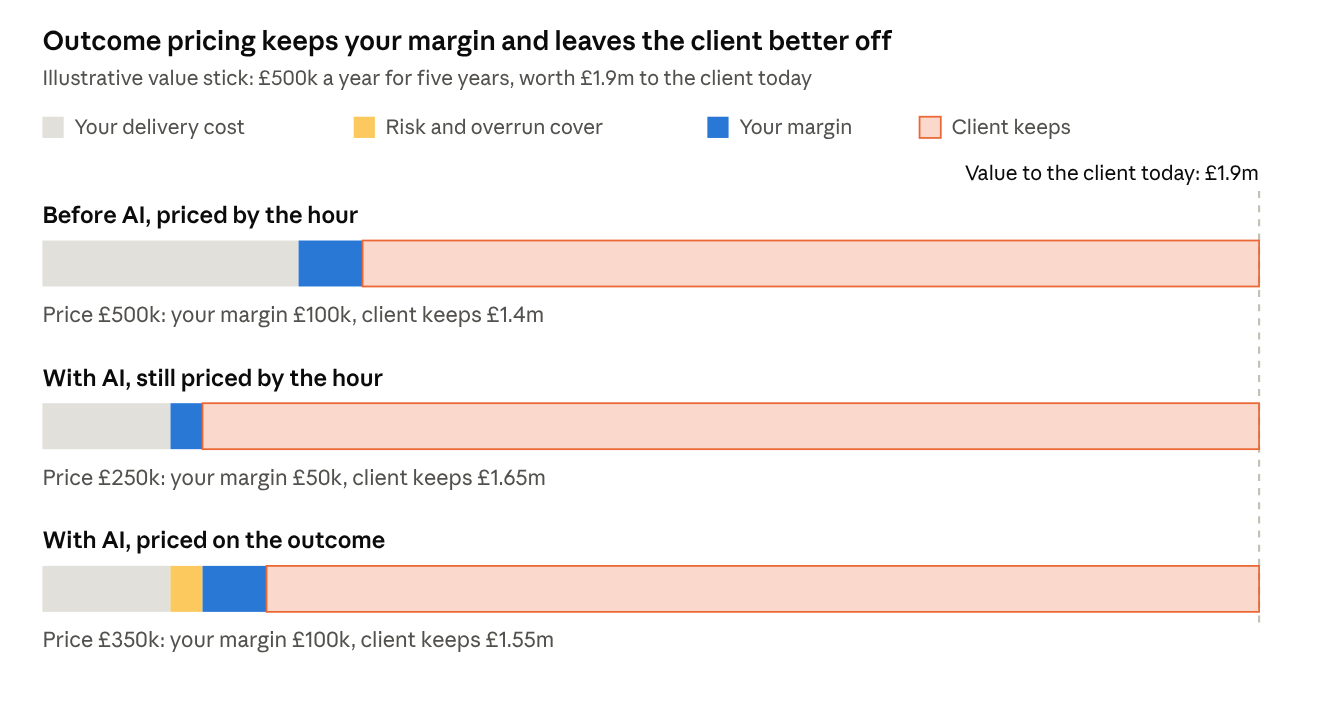
Priced by the hour, your margin halves and the client takes the whole saving. Priced on the outcome, you keep your margin and the client is still better off than before AI. The figures are illustrative: delivery cost halves from £400,000 to £200,000.
Set the price from the client’s next-best option
The value stick shows who keeps the gain. To set the number, McKinsey’s John Forbis and Nitin Mehta offered a more practical tool: economic value to the customer, or EVC. It starts from what the client could buy instead.
EVC = price of the next-best alternative + the extra value you deliver + the costs you save the client
Say a competitor would deliver the same result as a 12-month project for £280,000. You deliver in six months, so the client’s savings of about £42,000 a month start six months earlier, worth about £250,000. Your EVC is at least £530,000, before counting what your guarantee is worth to a client that no longer carries the delivery risk. Price below that, so the client still has a reason to choose you, and well above your £250,000 cost. Anywhere from £350,000 to £450,000 works for both sides. The figures are illustrative.
Sell certainty
Once the price sits on the outcome, the time AI saves shows up in your margin. The question is how to get there without a leap of faith on either side.
Start with a fixed-price pilot, so the client sees the result before it commits. Move repeatable work to a unit price: per process or per document, with each unit priced on the outcome it delivers rather than the hours behind it. Wrap ongoing work in a managed retainer with service levels. Where the benefit can be measured, share in the gain.
And price the quality as well as the speed. In a study by Harvard Business School and Boston Consulting Group, 758 consultants using AI finished tasks 25% faster, but the quality of their work rose by more than 40%. Fewer errors and less rework are worth paying for.
Guarantee when the benefits start
There’s a second guarantee that matters even more to a CFO: time to value. In the example above, every month of delay costs the client around £42,000 in savings it isn’t making.
The odds of delay are high. Only 30% of large technology programmes meet their timeline, budget and scope, according to Boston Consulting Group, and just 8.5% of the 16,000-plus projects in Bent Flyvbjerg’s database finish on time and on budget.
Length makes it worse. With Fortune 500 CIOs and CFOs staying in post for under five years on average, a 12-month project has about a one-in-three chance of losing one of them before it finishes. Halve the timeline and that falls to about one in five.
Speed also matters to the person signing off the work. An executive with a few years in post wants the transformation to land on their watch. It goes on their record, and if their bonus is tied to EBITDA, it shows up in their pay. A shorter project gives them that win while they are still in the job.
AI lets you deliver faster. So guarantee the date the benefits begin as well as the date the work ends, and back it with a rebate for every month you’re late. A quarter of the client’s monthly cost of delay would be about £10,000 a month in the example above. You carry the delivery risk, which you’re best placed to manage, and the client gets certainty in return.
Put your best people where it counts
None of this works without judgement. The same Harvard study found that on a task outside AI’s strengths, consultants using it were 19 percentage points less likely to reach the right answer.
That’s where senior experience earns its fee. Plan senior time at the points that decide the outcome: shaping the scope, deciding what AI can and can’t be trusted with, and signing off the result. With AI carrying more of the build, your most experienced people can apply that judgement across more projects without being spread thin.
Where to start
- Map the value: find the work you still price by the hour and put a number on what it is worth to the client, using the four formulas in the sidebar.
- Pilot one outcome: run a fixed-price, outcome-based engagement with a client you trust.
- Commit to a date: agree when the benefits will start and put a rebate behind it.
- Show the quality: build the quality gain into your proposals, not just the time saved.
- Rethink senior time: plan where your most experienced people add judgement, not hours.
The value was never in the hours
When a client asks why it’s still paying you, the honest answer is that it never paid for hours. It paid for a result, and for someone to stand behind it.
AI makes the hours cheaper. It doesn’t make accountability cheaper, and it doesn’t make your people less valuable. It frees them to focus on the judgement clients actually pay for. The firms that price for that will grow their margins. The ones that keep selling hours will spend the next few years explaining why they’re worth less.
Sidebar: four formulas to map the value
- Annual benefit = extra gross profit + costs removed. Use the client’s own KPI, such as EBITDA or the cost to serve a customer.
- Value today = annual benefit × (1 − (1 + r)⁻ⁿ) ÷ r, where r is the client’s required return and n is the number of years the benefit lasts. £500,000 a year for five years at 10% gives about £1.9 million.
- Payback in months = fee ÷ (annual benefit ÷ 12). A £350,000 fee against £500,000 a year pays back in about 8.4 months.
- Monthly cost of delay = annual benefit ÷ 12. That is about £42,000 here, and it sets the size of your time-to-value rebate.
If the payback is well inside a year and the return clears the client’s hurdle rate by a wide margin, the conversation moves from hours to value.
References
- Delivering value to customers (McKinsey Quarterly, June 2000, including John Forbis and Nitin Mehta on economic value to the customer)
- Validity of the single processor approach to achieving large scale computing capabilities (Gene Amdahl, AFIPS Conference Proceedings vol. 30, 1967)
- Amdahl’s law in the multicore era (Mark Hill and Michael Marty, IEEE Computer, July 2008)
- Value-based business strategy (Adam Brandenburger and Harborne Stuart, Journal of Economics & Management Strategy 5(1), 1996)
- Six economics lessons for managers (Ram Shivakumar, California Management Review Insights, August 2020)
- Better, Simpler Strategy (Felix Oberholzer-Gee, Harvard Business Review Press, April 2021)
- Google CEO says 75% of company’s new code is AI-generated (Semafor, April 2026)
- From pilots to payoff: generative AI in software development (Bain & Company Technology Report, September 2025)
- AI reshapes India’s IT services sector contracts as clients demand more for less (Reuters, via The Star, August 2026)
- Fin resolutions (Intercom help centre, September 2026)
- Rolls-Royce celebrates 50th anniversary of Power-by-the-Hour (Rolls-Royce press release archive, 2012)
- High hurdles: evidence on corporate investment hurdle rates in the UK (Bank Underground, Bank of England staff blog, August 2024)
- Navigating the jagged technological frontier (Dell’Acqua et al., Harvard Business School and BCG, September 2023)
- Most large-scale tech programs fail. Here’s how to succeed (BCG, November 2024)
- Bent Flyvbjerg on megaprojects (Thought Economics, December 2023)
- The other turnover in the C-suite (Korn Ferry, November 2025)


More insights